
A trip on your own gives you control over the day’s rhythm. It also means you handle every decision yourself: where to stay, when to leave, who to trust and what to do if plans change. Solo travel in Israel can involve museums, city neighborhoods, guided day trips and hostel conversations, but current security conditions deserve serious attention before any sightseeing plan.
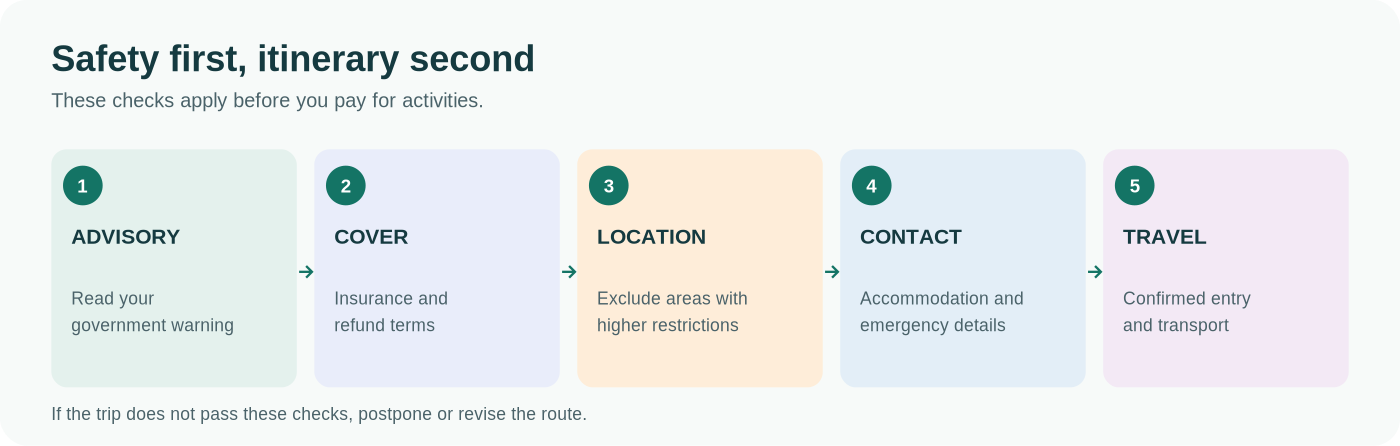
Short answer: Check government travel warnings first. If you decide to travel despite applicable warnings, choose accommodation with a reachable reception and a known protected space, arrange your arrival in daylight, keep a backup transport option and join structured social activities rather than relying on chance encounters. As of 3 November 2026, the U.S. State Department’s 23 October advisory says Level 3: Reconsider travel, with higher-risk areas subject to Do Not Travel warnings. The UK FCDO also advises against travel to specified areas and warns of possible rapid escalation. An article cannot override those advisories.
Is Israel suitable for a solo trip right now?
The answer depends on your nationality, route, risk tolerance and the advice in force when you depart. There is no responsible blanket promise of safety. Current concerns include terrorism, unrest, potential attacks, flight disruptions, local restrictions and differences between regions. A trainable itinerary is not the same thing as an appropriate itinerary.
Before booking nonrefundable travel, read your government’s full destination guidance, including the map and any areas where travel is discouraged or prohibited by advice. Confirm whether your insurer covers the proposed trip when an advisory is in effect. Keep your airline’s change terms and your accommodation’s cancellation conditions available offline.
For emergencies, the Israeli Ministry of Tourism directs visitors to official Home Front Command information. In Israel, the emergency numbers are 100 police, 101 ambulance, 102 fire and rescue, and 104 Home Front Command. Follow local directions immediately if an alert is issued; do not treat a travel blog as a shelter guide.
Choose a base that helps you feel independent
A first solo night is easier when the basics are simple: direct transfer information, staffed check-in, an accessible common area and a room type you are comfortable sharing. It can be worth paying more for a straightforward location rather than arriving after dark at an unfamiliar address with several connections.
| Accommodation type | Social potential | Privacy | Useful check before paying |
|---|---|---|---|
| Hostel dorm | Casual conversations and group activities | Shared sleeping and storage | Lockers, bed layout, quiet hours, reception, protected space |
| Private room in a social hostel | Shared common areas without sharing a bedroom | Higher | Whether activities and common rooms are available to private-room guests |
| Guesthouse | Often a smaller, quieter environment | Varies | Reception coverage and local help after hours |
| Apartment or self-check-in rental | More independence; fewer built-in meetings | Usually higher | Exact entry process, emergency information, support contact |
A hostel can be social, but no accommodation guarantees friendship or a particular group composition. Read recent reviews for specific operational details, not only overall ratings. Check whether the property is currently trading and can provide up-to-date guidance about local restrictions.
For an Abraham example, the official Abraham Tel Aviv page lists shared spaces and room types, while Abraham Eilat lists dorms, private rooms and common areas. Verify dates and facilities when booking. Do not book Abraham Jerusalem or Fauzi Azar in Nazareth on the assumption that they are open: Abraham’s group reports describe the Jerusalem property as temporarily closed and the earlier Nazareth closure.


How to meet people without depending on strangers
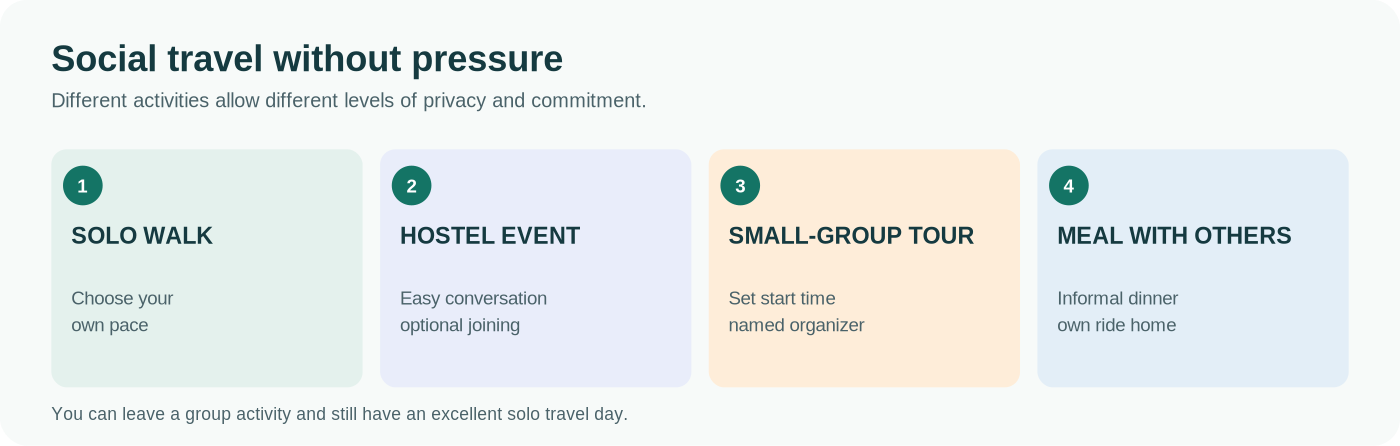
The easiest first conversation often happens around a shared activity. Hostel walking tours, a group meal, a language exchange, a scheduled museum tour and a small-group excursion provide a common purpose. You can talk when you feel like it and leave without needing to invent a reason.
Start with activities run by identifiable organizations. Check the organizer’s published date, meeting point, price, languages, group size and cancellation policy. Be cautious about offers that move immediately to private messaging, demand advance payment to an individual’s account or pressure you to change locations after you have agreed to meet.
Try a manageable social routine:
- Ask reception about one organized group activity with a confirmed departure.
- Introduce yourself to other participants without sharing your exact room number or full itinerary.
- Keep your phone charged and independently verify the route home.
- Choose a public meeting place for anyone you first meet online.
- Leave when you want to; an enjoyable social trip does not require late nights.
Shared accommodation is only one way to meet people. Travelers who prefer a private room can still join daytime activities and reserve evening downtime. For a broad selection of travel styles and destinations, the separate Israel travel for young adults guide covers choices beyond traveling alone.
Make the first 24 hours unusually easy
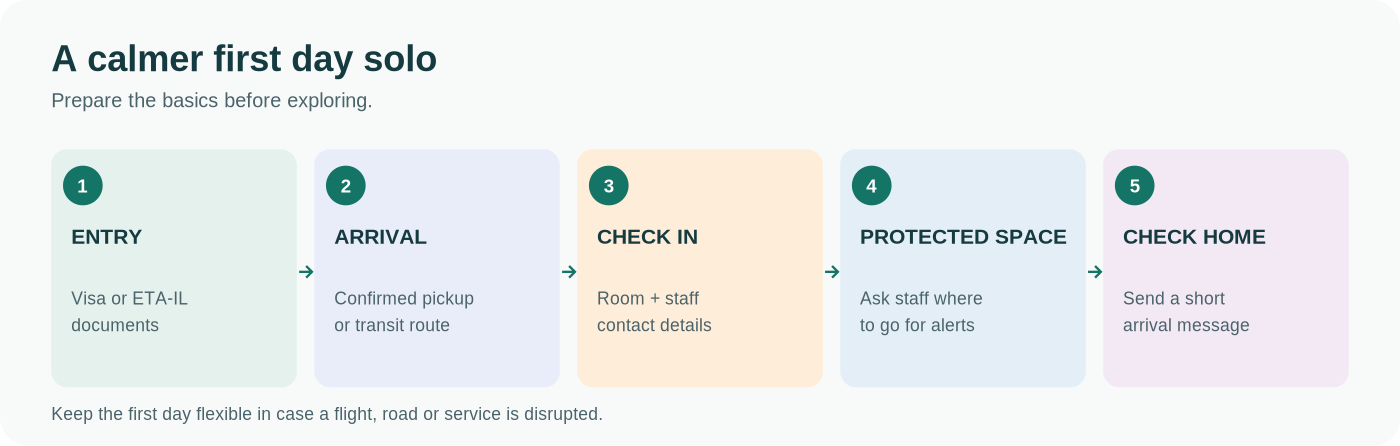
Flight schedules and border procedures can change, so avoid a tight sequence of nonrefundable connections on arrival day. Confirm immigration requirements before departure using the official Israel entry portal; many visa-exempt visitors need an approved ETA-IL before travel. Rules depend on citizenship and status, and an approval does not guarantee admission.
Save your destination address in English and Hebrew if possible. Download an offline map, keep the lodging’s contact number handy and confirm how you will get from the airport or station to the property. If you expect to arrive during Shabbat or a Jewish holiday, review the service restrictions before purchasing the flight.
Ask your accommodation where the nearest designated protected space is and what staff expect guests to do during an alert. Official instructions can change, so check them on arrival. Share a simple check-in schedule with a trusted person at home, especially if you will spend the day out of mobile coverage.
Transport for one person: plan both directions
Israel has intercity rail and bus services and local urban transit in many places, but coverage, last departures, service alerts and Shabbat schedules vary. Solo travelers are especially exposed to the small mistake of planning a one-way outing without a reliable return route. The fuller Getting Around Israel Without a Car guide explains ticketing and the broader network.
For every trip, write down a Plan A and Plan B. Plan A might be an operating train or bus, while Plan B could be postponing the outing or arranging a licensed taxi from a trusted provider. Check the service directly, not just a route displayed in a mapping app. Do not accept rides from unknown drivers who approach you near a station; arrange transport through a recognized channel.
If a tour crosses into a region with a higher-level government warning, do not assume the presence of a professional guide makes the journey appropriate. Check the precise route, operator and legal or insurance implications yourself.
What about Friday evenings and Saturdays?
Most regular national public transportation pauses for Shabbat; local exceptions exist, and Tel Aviv operates a municipal weekend shuttle system. In Jerusalem, walking-distance planning is usually more relevant than trying to combine several destinations by transit. See the specialized Jerusalem on Shabbat guide for venue and opening-hour checks.
Personal safety without turning the trip into a checklist exercise
Practical habits help with ordinary travel situations, although they do not remove conflict-related risk. Lock valuables, separate your backup bank card from your everyday wallet and do not leave your phone unattended on a beach or café table. Keep a digital copy of essential documents in a protected account and know how to contact your embassy if your passport is lost.
If a conversation, date or group outing becomes uncomfortable, leave without apologizing. Tell a trusted contact where you expect to be, and arrange a route home that does not depend on the person you just met. At bars, keep an eye on your drink and set spending limits before ordering. Never assume a group is safe because it includes other tourists.
Women traveling alone may prefer a female-only dorm, a private room or a smaller organized tour; none of these options is mandatory. LGBTQ+ travelers should read the latest region-specific advice rather than treating every neighborhood or destination as socially identical. Accessibility needs, disability-related arrangements, religious practice and personal comfort also affect which lodging and activities work best.


Local customs matter when you are traveling alone
Israel contains communities with different languages, religious traditions, customs and political outlooks. Tel Aviv’s beach neighborhoods and Jerusalem’s religious districts do not have identical expectations. Wear appropriate clothing at sacred places, observe posted rules and ask before photographing people, particularly in places of worship or areas where photographing security installations is prohibited.
When asking about a sensitive subject, approach it as a conversation rather than an opportunity to demand personal opinions. Some people will want to share their experiences; others will not. In mixed groups, avoid assuming that everyone represents the same community or worldview.
Learning a few Hebrew and Arabic greetings can make everyday exchanges more courteous, but do not assume everyone speaks either language. English is common in many tourist settings, though it is not a replacement for written directions and clear confirmation of arrangements.
A social day without an overly packed schedule
You do not need a seven-day timetable to make a solo day work. A modest framework is often enough:
| Part of day | Low-pressure activity | How to keep it flexible |
|---|---|---|
| Morning | Breakfast and one walkable neighborhood or museum | Check opening and any local alerts |
| Midday | Scheduled group activity or guided cultural visit | Join only a verified organizer |
| Afternoon | Free time, laundry, journaling or a café | Keep time for transport changes |
| Evening | Hostel event or dinner with people you met | Arrange your return independently |
This deliberately avoids prescribing where to travel during changing security conditions. If your main question is how many destinations fit in one week, see the separate 7-day Israel itinerary. If room types and shared facilities matter most, use Hostels in Israel to compare lodging criteria.
Before you book: seven decisions
- Go or postpone? Compare official national advisories, insurance and your personal risk assessment.
- Which region? Exclude routes your government or authorities currently advise against.
- Which accommodation? Confirm operating status, check-in, lockers and protected-space information.
- How will you arrive? Check transport schedules, weekends and backup options.
- Who is your check-in contact? Give someone at home a short communication plan.
- Which social activity? Book one verified event instead of five unconfirmed ideas.
- What if plans change? Keep copies of documents and know how to get local assistance.
Frequently asked questions
Is Israel safe for solo travelers in November 2026?
It would be misleading to call it broadly safe. The U.S. State Department listed Israel at Level 3, Reconsider travel, on 23 October 2026, with higher-risk areas carrying stronger warnings. Read your own government’s current advice before deciding.
Can I meet other travelers if I book a private room?
Yes. Common areas, scheduled tours and group activities can be social without requiring a shared dorm. Check that the property actually runs the activity on your dates.
Should I travel alone across Israel by public transport?
It depends on the route, service and current security advice. Do not start a journey without checking whether the return service operates, especially around Shabbat.
Do I need an ETA-IL to enter Israel?
Many nationals of visa-exempt countries do. Verify your eligibility and apply through the official government portal before departure; rules depend on your passport and circumstances.
What emergency numbers should I save?
In Israel: police 100, ambulance 101, fire 102, and Home Front Command 104. Follow local official instructions and your accommodation’s directions if an alert is issued.
Sources and editorial verification
Checked 3 November 2026: U.S. State Department travel advisory; UK FCDO warnings; UK safety guidance; Israeli Ministry of Tourism emergency guidance; official Israel entry portal; Abraham Tel Aviv; Abraham Eilat; Abraham impact report.
Editorial update policy: review at least every six months, and urgently whenever travel advisories, entry requirements or accommodation operating status change. Suggested internal URLs must be checked in the CMS.