
You can travel between many major destinations in Israel without renting a car. Trains connect key coastal and inland cities; buses reach places that the rail network does not. The harder parts are usually the last few kilometers, journeys on Friday and Saturday, and knowing which payment method works on a particular service.
Quick answer: Use rail for major corridors where service is available, intercity buses for other destinations, and local buses or light rail for city journeys. Plan every trip for its exact date and time, not just the route. Most regular trains and many buses stop for Shabbat, while some municipalities provide limited alternative weekend services. Keep a backup plan for late arrivals and disruptions.
The main ways to travel without a rental car
| Mode | Best for | What to check before leaving |
|---|---|---|
| Israel Railways | Fast intercity travel on rail-connected corridors | Departures, service notices, station access and last-mile transport |
| Intercity bus | Cities and destinations beyond the rail network | Exact stop, service operator, reservations where required and weekend service |
| City bus | Affordable journeys inside metropolitan areas | Route direction, validation method, transfer rules and final service |
| Light rail | Urban corridors in cities with operating lines | Platform or station, validation and service changes |
| Licensed taxi | Late trips, heavy luggage or gaps in public transport | Fare estimate, official pickup point and traffic |
| Organized transfer or tour | Places difficult to reach on scheduled transport | Departure location, cancellation terms and whether the service is operating |
There is no single “best app” that replaces a timetable check. Use an official operator or the National Public Transportation Authority to verify the service, and a route-planning app to understand connections. For a multi-city example, see our 7-day Israel itinerary.
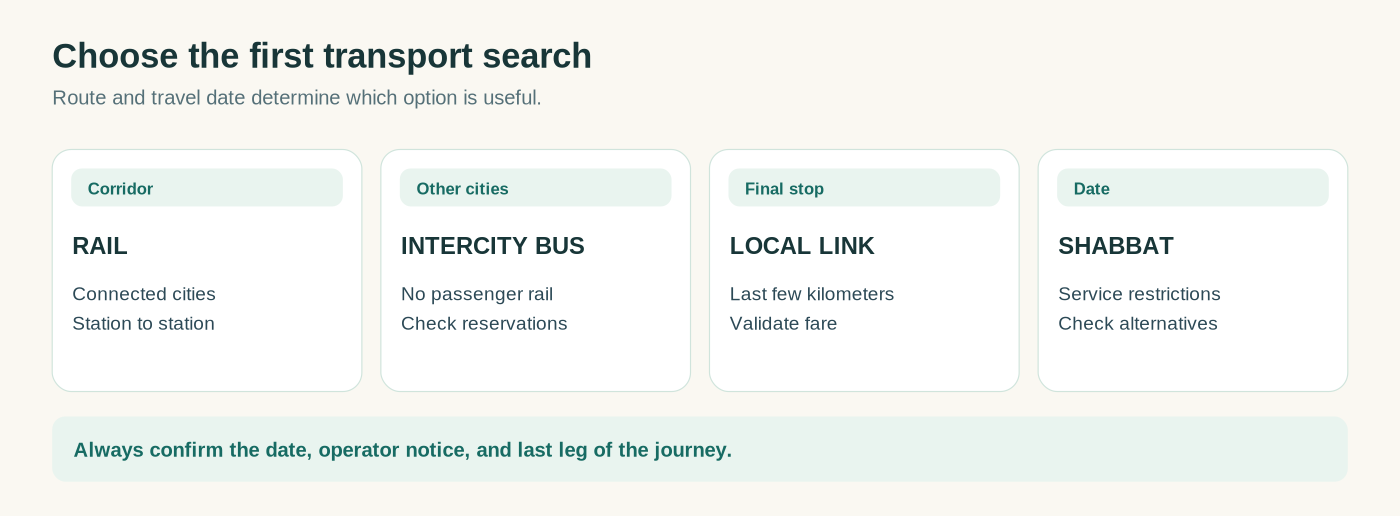
Train travel: the main intercity corridors
Israel Railways is useful for many trips involving Tel Aviv, Jerusalem, Haifa, Ben Gurion Airport and other rail-connected destinations. It can spare you a long road journey in traffic, but you still need to account for how far the station is from your accommodation.
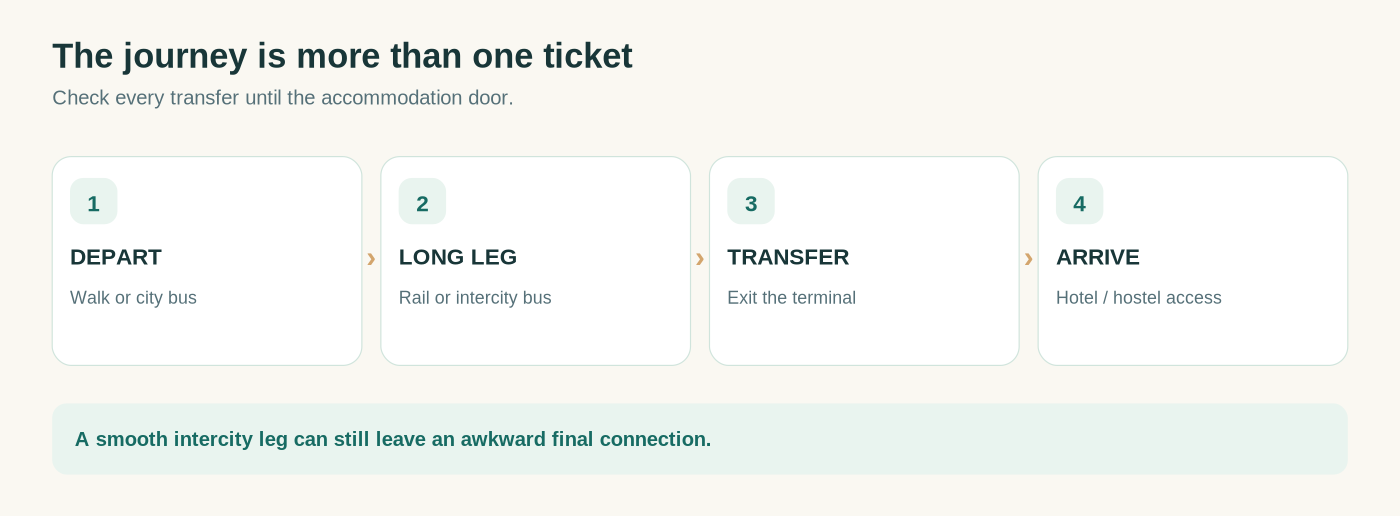
A common example is Tel Aviv–Jerusalem: trains serve Jerusalem–Yitzhak Navon station, but that station is not in the Old City. Allow time for the onward local connection and for finding the correct station entrance. Another common rail journey links Ben Gurion Airport and Tel Aviv; depending on your destination, a bus or walk may still be necessary after the train.
An important exception is Eilat: do not plan on taking a passenger train directly to the city. Travelers commonly use intercity buses or other appropriate transport after checking current service. The Egged operator’s reservation routes include Tel Aviv–Eilat and Jerusalem–Eilat options, but route listings do not establish departure availability for your date.


How to check a train journey
- Enter your actual departure station and arrival station, not only city names.
- Set the correct day of the week and preferred departure or arrival time.
- Check planned engineering works and service notices; don’t rely on a saved screenshot.
- Confirm the correct platform and allow extra time in unfamiliar stations.
- Work out how to reach the final address after leaving the station.
The Tel Aviv municipal transport guide explains the rail connection and warns that services stop around Shabbat. Avoid quoting fixed train journey durations without a journey-specific search; stopping patterns and connections can change.
Intercity buses: where rail does not reach
Buses are important for travel to places such as Eilat and many smaller towns. Some long-distance routes involve advance seat reservations. Your plan needs to identify both the exact terminal and the correct direction of travel: a city may have multiple major bus stops with similar names.
| Example journey | First mode to investigate | Common detail travelers miss |
|---|---|---|
| Tel Aviv to Jerusalem | Rail, then relevant local link; compare buses | Your exact departure neighborhood may make a bus more convenient |
| Jerusalem to Eilat | Intercity bus | Departures can require a seat reservation; it is a long road trip |
| Tel Aviv to Eilat | Intercity bus | Different route numbers can have different boarding points |
| Ben Gurion Airport to Tel Aviv | Rail or suitable onward service | Check the arrival terminal, time of day and onward journey |
| Tel Aviv to Haifa | Rail | Accommodation may be up a hill away from the station |
| Jerusalem city center to the Old City | Walking, city bus or light rail plus walking | Streets and entrances can affect the final walking route |
These are planning options, not promises of a departure on a particular date. The Egged reservation information lists relevant long-distance corridors, and the national transport authority provides route-planning information.
Paying for public transport in Israel
Rav-Kav is a widely used transport card. You load eligible tickets or value and validate it for travel. Certain phone apps can also be used to pay, though app onboarding and supported payment cards should be checked before arrival. Methods can differ by operator, mode and station.
The Rav-Kav Online visitor guide, checked on 3 November 2026, lists an indicative ₪8 short urban ride and an ₪17.50 bus-only city day pass, subject to the relevant conditions. It also shows example rail fares by route. Those numbers are a dated reference, not a guarantee that the fare for your particular trip is identical.
For mobile payment, the Tel Aviv visitor transport guide and NTA’s Dankal guide name apps such as Moovit, Rav-Pass and Pango, and explain when validation is required. At some underground light-rail stations, a barcode must be presented at a gate. For local buses, use the appropriate validation method when you board.
Rav-Kav card versus a payment app
| Question | Rav-Kav | Payment app |
|---|---|---|
| Can I use it without relying on phone battery? | Yes, once loaded and valid | No; keep phone charged |
| Do I need to set it up before traveling? | Obtain/load the card | Install app, register and confirm accepted payment method |
| Are the fares and concessions automatic? | Depends on loaded product/profile | Depends on app and eligible profile |
| Should I validate each journey? | Yes, according to the mode’s rules | Yes, using the relevant QR or in-app process |
| Should I carry a backup? | Good idea | Good idea, particularly on a long multi-leg trip |
Don’t assume a foreign payment card will work with every app. Also do not assume ordinary contactless bank-card tapping is accepted uniformly across all networks; verify the rules for the operator you will use.
Shabbat and public transport: plan the gap
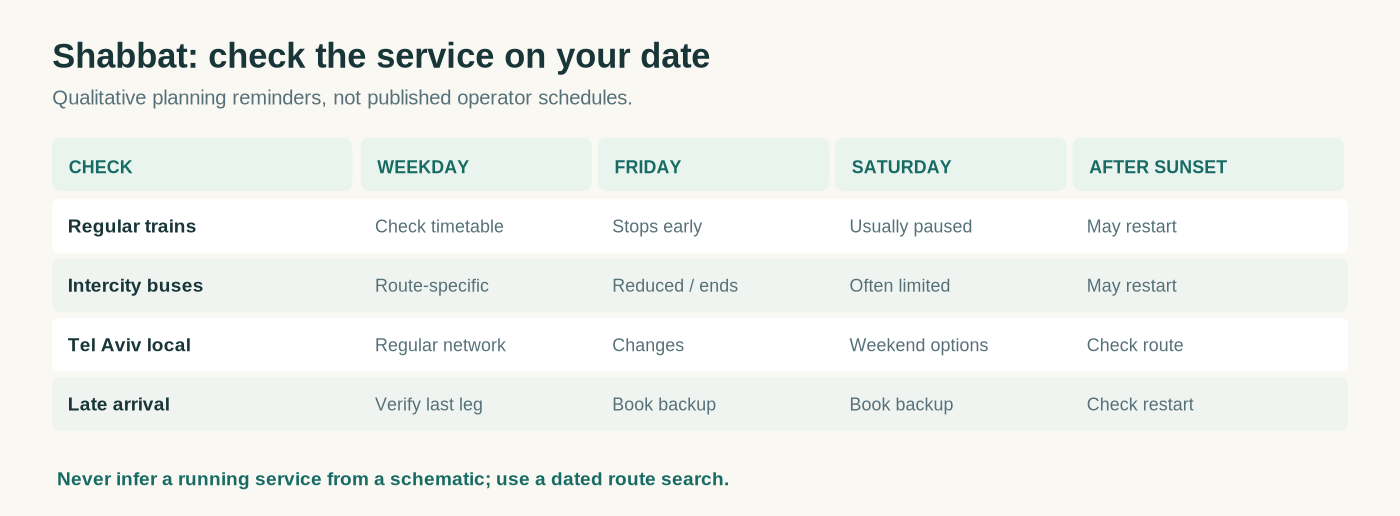
Shabbat generally runs from Friday before sunset to Saturday after sunset, with times varying by date and location. Much of the regular intercity train network and many bus services stop during that period. The exact wind-down and restart times must be checked for your specific journey.
A particularly important exception is the free municipal Na’im Busofash weekend service in parts of the Tel Aviv metropolitan area. The city’s official visitor guidance describes the network and points travelers toward its updated routes and hours. This is not a substitute for intercity trains or a guarantee of door-to-door coverage.
The Friday arrival problem
An itinerary that says “arrive in Jerusalem Friday evening and take the train” may fail if the train has already stopped. Work backward from the final local journey to the airport or bus terminal. If you cannot confirm every leg, book accommodation where you can arrive safely with a planned, affordable transfer.
The same caution applies to Saturday-night departures. Services may restart after Shabbat but not necessarily at the moment you need them. Check a concrete itinerary rather than assuming everything resumes immediately after dark.


Five ways to make a car-free trip easier
Sleep near a useful connection. Look at the route between your hostel and the intercity station. A property close to a direct bus can save time even if it is slightly farther from one attraction. See our hostel selection guide.
Travel light enough for transfers. Stairs, crowded stations, outdoor bus stops and long walks make heavy luggage more than a minor inconvenience. Check step-free access if necessary.
Keep a time buffer. Domestic connections can be delayed or altered, and security procedures can affect your movement. Do not schedule an important international flight immediately after a long and uncertain ground transfer.
Check the weather and service notices. Heat, rain and disruption can change the practicality of a walk or a road leg. If an official advisory applies to your destination, adjust the trip rather than treating public transport availability as proof of safe access.
Save an offline fallback. Store your destination address in Hebrew and English, an alternative transport option and your accommodation’s direct contact details. Do not depend on one app being usable at every point of the journey.
Travel safety and service disruptions
Transport service is not a safety clearance. The U.S. State Department’s 23 October 2026 Israel advisory remains Level 3, “Reconsider Travel,” and includes stricter restrictions for specified areas. Check your own government’s advice, current local instructions and operator notices before departure. Avoid routes into areas subject to a do-not-travel warning.
If the journey depends on an unusual border crossing, a remote site or a long overnight leg, confirm the full plan with official sources instead of using a broad nationwide travel article as a timetable.
Frequently asked questions
Can you see Israel without renting a car?
Many major cities and tourist areas can be connected using trains, buses and local transport. Remote destinations, Shabbat journeys and some night arrivals require more planning.
Do trains run in Israel on Saturday?
Regular train service generally pauses for Shabbat. Exact restart times and exceptions must be checked for your date.
Can I pay for Israeli buses with my phone?
Supported transport-payment apps allow this on many services after registration and correct validation. Check whether your card and phone are supported before relying on the app.
Is there a train to Eilat?
Do not plan a direct passenger-rail arrival in Eilat. Check intercity bus services, appropriate transfers or other available options.
Should I buy a Rav-Kav or use an app?
Both can work. A Rav-Kav is useful as a separate physical payment method; an app may simplify fare management. Choose based on your routes, payment-card compatibility and preference for a backup.
Sources and update checklist
- National Public Transportation Authority — official transport information.
- Rav-Kav Online — visitor guide and reference fares.
- NTA — Dankal light-rail payment rules.
- Tel Aviv visitor guide — local and weekend services.
- Egged — routes with seat reservations.
- U.S. State Department — Israel travel advisory.
Fact-check date: 3 November 2026. Check schedules and prices on the travel date. The proposed internal links require a live CMS audit before publication.