
How much money do you need for Israel? It depends less on how many famous places you visit than on where you sleep, how often you eat in restaurants and whether you book long-distance transport sensibly. A few “cheap” days can be undone by one expensive taxi, last-minute room or missed connection.
For an initial planning figure, set aside around ₪360 per person per day for a restrained, hostel-based trip, or around ₪795 per person per day for a private-room trip with more paid activities. These are illustrative budgets built from assumptions, not measured 2026 price averages, hotel quotes or guarantees. The itemized tables below let you replace every assumption with actual prices for your dates.
Israel travel costs at a glance
| Cost category | Lean planning assumption | More flexible planning assumption | What is and isn’t verified |
|---|---|---|---|
| Accommodation, per person per night | ₪170 dorm bed | ₪440 private room used by one traveler | Example allowances; search live room rates and taxes |
| Food and drinks, per day | ₪95 groceries and simple meals | ₪160 mix of inexpensive meals and cafés | Example allowances, not published average menu prices |
| Local transport, per day | ₪18 | ₪30 | Allowances; official urban single fare is usually ₪8 and bus-only city day pass ₪17.50 for eligible travel |
| Attractions and experiences, per day | ₪40 | ₪100 | Example averages across free and paid days |
| Contingency, per day | ₪35 | ₪65 | Travel-planning buffer, not an operator’s price |
| Illustrative total, per person per day | ₪358 | ₪795 | Excludes flights, some intercity journeys, insurance and entry documents |
Price-check date: 3 November 2026. Official public transport figures were checked against Rav-Kav Online’s visitor fare page and the government’s fare table. Accommodation, meals and discretionary expenses are editorial assumptions to adjust after obtaining current quotes. The table does not present them as statistical averages.
What a full week can cost
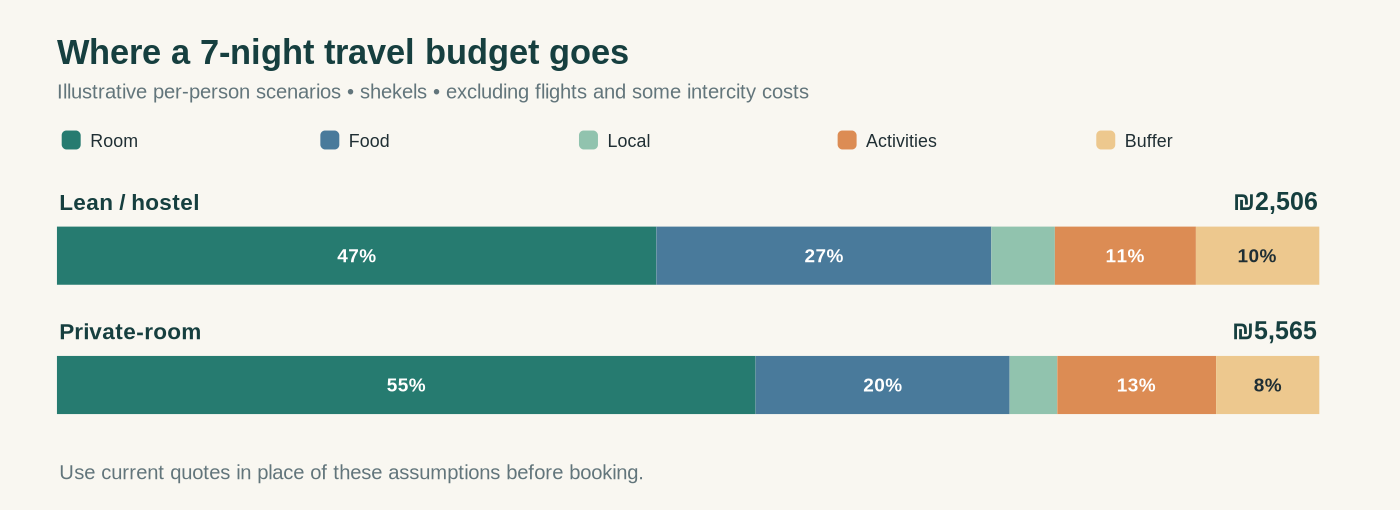
Seven nights multiplied by a daily budget is a useful starting point, but it misses some one-off expenses. Here is a simple worked example for one traveler:
| Expense for 7 days / 7 nights | Lean hostel trip | Flexible private-room trip |
|---|---|---|
| Accommodation | ₪1,190 | ₪3,080 |
| Food and drinks | ₪665 | ₪1,120 |
| Local transport | ₪126 | ₪210 |
| Attractions and activities | ₪280 | ₪700 |
| Contingency | ₪245 | ₪455 |
| Core week total | ₪2,506 | ₪5,565 |
| Add separately | Intercity tickets, flights, insurance, entry formalities, airport transfers | Same; also any higher-end tours or taxis |
The examples assume one person paying for a private room alone in the flexible scenario. A private room shared by two can change the per-person calculation substantially. There are no flights or international transfers in either total.
Accommodation: the largest decision for many travelers
A dorm bed can reduce the cost of a week dramatically, especially if your alternative is paying for an entire room alone. But don’t compare the headline price without checking what it buys. One hostel may include linens and a kitchen; another price may exclude breakfast or have a restrictive cancellation policy. A lower rate in a distant neighborhood may lead to higher transport costs.
To build the accommodation line of your budget, search the actual dates, number of people and room type. Check final tax handling, currency, cancellation terms and whether the property is operating. Split the full private-room total between travelers only when they are genuinely sharing it. A dorm bed is priced per person; a private room is usually priced per room.
Abraham currently maintains accommodation pages for Tel Aviv and Eilat. Use current booking availability rather than relying on a historic minimum price. The former Abraham properties in Jerusalem and Nazareth should not be assumed to be bookable. Our hostel selection guide compares what to look for in social accommodation without ranking rooms by a price that may expire tomorrow.


Public transport: prices you can check
Public transport is one of the easier expense lines to calculate because fare information is published. On the Rav-Kav Online visitor guide, checked 3 November 2026, a typical short-distance urban ride is listed at ₪8. The published example of a bus-only city day pass is ₪17.50, and a city day pass including train travel is ₪23 for the relevant distance band. Eligibility, distance and mode matter; those passes are not valid for every national journey.
| Example journey or fare product | Published fare | Important distinction |
|---|---|---|
| Typical urban single ride | ₪8 | Fare depends on distance and mode |
| Bus-only city daily pass | ₪17.50 | Applies to the eligible area/distance tier |
| City daily pass including train | ₪23 | Check the exact rail/distance tier |
| Tel Aviv–Ben Gurion Airport train | ₪11.50 | Station pair on Rav-Kav’s example table |
| Tel Aviv–Jerusalem train | ₪27 | Example city pair on the visitor fare table |
| Tel Aviv–Haifa train | ₪30.50 | Example city pair on the visitor fare table |
These are published fares as viewed on 3 November 2026, not locked-in prices for a later departure. Check the operator or Rav-Kav immediately before traveling. The transport ministry’s underlying government fare update was published in April 2025; future changes may not be reflected here.
A big hidden cost is Shabbat. Many ordinary trains and buses stop or reduce operation from Friday afternoon into Saturday evening. A long taxi in place of an unavailable intercity train can outweigh several days of savings. Tel Aviv operates a free municipal weekend transport network, but it does not mean all journeys across Israel are free or possible. For route decisions, see our getting around Israel without a car guide.
Food: keep your budget flexible
Food costs change quickly with neighborhood, appetite and the kind of place you choose. The ₪95 and ₪160 daily meal allowances in our examples are planning choices, not fixed menu prices. If you buy groceries for breakfast, eat a simple lunch and choose one casual evening meal, the lower example may be workable. If coffee, restaurant meals, alcohol and delivery are part of every day, plan considerably more.
A hostel kitchen can help, particularly on longer stays. You don’t have to cook every meal. Buying fruit, yogurt, bread or other easy foods reduces the pressure to find a restaurant three times a day. In markets such as Mahane Yehuda, browsing is free but anything you order adds to the budget. Use posted menus to make decisions; don’t assume a food stall is automatically cheaper than a small café.


Tours, museums and free attractions
Don’t divide the full cost of a paid tour evenly across every day and assume the arithmetic describes reality. Instead, list the particular experiences that matter: museum tickets, a guided city walk, a snorkeling activity, an organized desert outing or another confirmed event. Enter the current checkout price for each and add any travel or equipment costs.
Then build free time around them. Jerusalem has public Old City streets, the Western Wall plaza and Gazelle Valley Park, which explicitly states that entrance is free. The free things to do in Jerusalem guide separates genuine zero-admission places from paid attractions. Free entry does not mean a venue is open at all hours; check religious and park access rules.
For guided excursions, compare the price you pay with what is included. An advertised activity may or may not cover transport, admission fees, gear, meals or cancellations. Read the actual product terms. If a tour departs from another city, that transfer belongs in the budget too.
The costs people forget
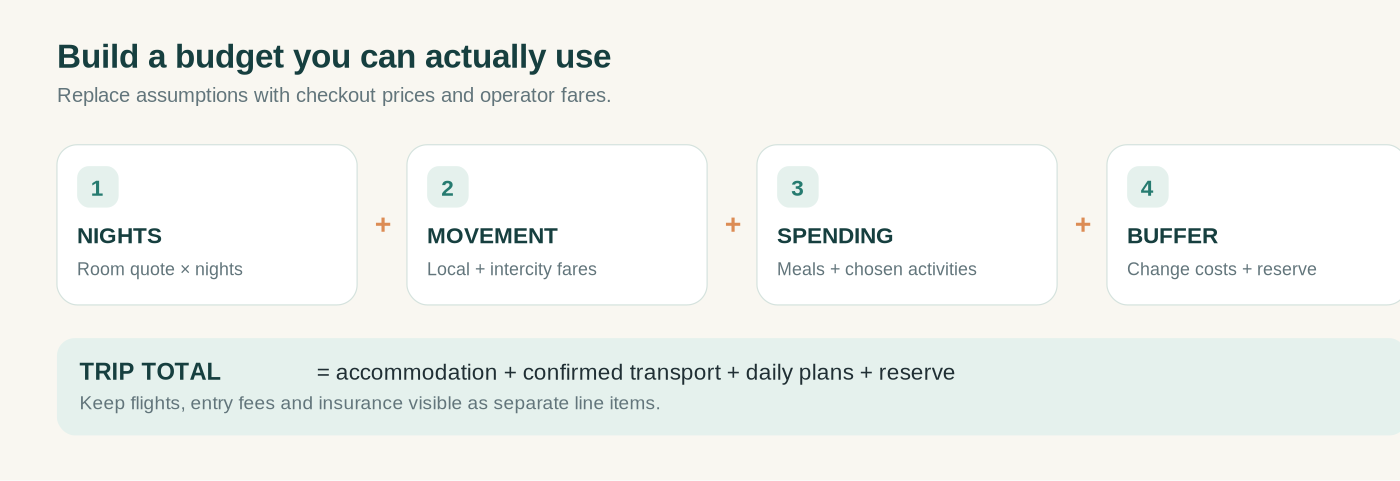
A useful travel budget includes the less exciting expenses before they become expensive surprises:
- Airport transfer: The cheapest ordinary public route may not run at your landing time or on Shabbat.
- Travel insurance: Price a policy appropriate to your nationality, medical circumstances and official destination advice; exclusions may apply.
- Entry paperwork: Visa-exempt travelers may need ETA-IL. The published application fee is ₪25; verify on the official site before payment.
- Connectivity: A mobile data plan or roaming package may be necessary for navigation and alerts.
- Bank charges: Check foreign transaction fees and ATM costs; exchange-rate movements affect foreign-currency budgets.
- Schedule changes: A second night, rebooked journey or taxi can cost far more than a small daily allowance.
Your emergency reserve should be separate from routine café spending. It may be worth holding funds in an account or payment method you can access if one card fails.
Six ways to spend less without making the trip harder
- Choose fewer overnight bases. Two cities may be cheaper than three once intercity transport and check-in time are included.
- Book rooms with cancellation terms that fit the situation. A non-refundable bargain isn’t always a bargain when plans change.
- Use the kitchen selectively. A few self-prepared meals can free up money for a meaningful paid activity.
- Compare daily transit passes with individual fares. Two short rides may cost less than an inappropriate pass; repeated journeys may justify it.
- Put paid attractions on specific days. Keep other afternoons for parks, beaches or public streets rather than buying tickets out of habit.
- Avoid a Shabbat transport surprise. Plan the week around realistic departures, not only around which day looks cheapest in your calendar.
Safety and the cost of changes
As of 3 November 2026, the U.S. State Department advised reconsidering travel to Israel, with additional restrictions in certain regions. Advice for other nationalities may differ. A financial plan cannot make an unsafe trip acceptable. Review official government guidance before making non-refundable bookings and confirm airline, insurer and accommodation cancellation policies. If advice changes, prioritize safety rather than trying to recover the value of prepaid excursions.
Frequently asked questions
How much money should I budget per day in Israel?
For a first draft, this guide models ₪358 per person per day for a lean hostel trip and ₪795 for a more flexible solo private-room trip. These are illustrative allowances, not measured average traveler spending. Replace them with current quotes before booking.
Is Israel expensive for backpackers?
It can be, especially when accommodation, meals out and long taxi rides add up. Shared rooms, fewer city changes, self-catering and selective paid activities make a clear difference.
Are train and bus tickets expensive in Israel?
Official examples include an ₪8 urban single ride and a ₪27 Tel Aviv–Jerusalem train fare on the current published visitor table. The exact fare depends on distance, mode and any later tariff change.
Does the seven-day budget include flights?
No. The sample weekly totals also exclude some intercity travel, travel insurance, entry paperwork and airport transfers. Those depend strongly on the departure country and itinerary.
Sources and pricing notes
- Rav-Kav Online — visitor fare examples, viewed 3 November 2026
- Israel Ministry of Transport — fare schedule published April 2025
- Tel Aviv–Yafo Municipality — free weekend transport
- Israel Population and Immigration Authority — ETA-IL
- Gazelle Valley Park — no-fee entry
- U.S. State Department — travel advisory
Pricing-method note: published transport amounts are attributed to official or operator-facing fare sources; lodging, meal, activity and buffer amounts are explicit editorial scenario inputs. Do not relabel those inputs as verified market averages or “average 2026 prices” in snippets, ads or automated answers.