
A good one-day Jerusalem walking itinerary is about choosing a route, not ticking every landmark off a list. The Old City has steep stone lanes, living places of worship, market passages and a dense history that takes time to absorb. This self-guided day starts and ends at Jaffa Gate, takes you through the Armenian and Jewish Quarters, reaches the Western Wall, then turns toward lanes associated with the Via Dolorosa and the Church of the Holy Sepulchre.
Quick answer: Set aside 6–8 hours, including breaks, for a roughly 3–5 km walking day (a planning estimate that depends on detours and which lanes are open). Start near 09:00, keep time flexible around prayer services and security checks, and allow extra time for stairs and slopes. The walking route itself does not require a paid guided tour, but optional attractions may charge admission. For access guidance, consult iTravelJerusalem’s Old City entrance guide and Western Wall visitor information.
Jerusalem walking route at a glance
| Suggested time | Stop | Allow | Why it belongs on this walk |
|---|---|---|---|
| 09:00 | Jaffa Gate and Tower of David exterior | 20–30 min | Easy orientation and a clear meeting point |
| 09:30 | Armenian Quarter lanes | 20–30 min | Quieter stone streets and historic community setting |
| 10:00 | Jewish Quarter and Cardo | 45–60 min | Archaeological and streetscape context |
| 11:00 | Western Wall Plaza | 30–45 min | Major sacred public space; visitor rules apply |
| 12:00 | Lunch / rest near central market lanes | 45–60 min | A genuine break before the second half |
| 13:15 | Muslim Quarter passages and sections of Via Dolorosa | 45–60 min | Busy markets and Christian pilgrimage associations |
| 14:15 | Church of the Holy Sepulchre | 60–90 min | Important shared Christian sacred site |
| 15:45–16:30 | Christian Quarter → Jaffa Gate | 20–45 min | Easy route back to your starting point |
These are suggested pacing windows, not opening-hour promises or exact street-by-street navigation instructions. Security measures, worship and crowd conditions may change the order.
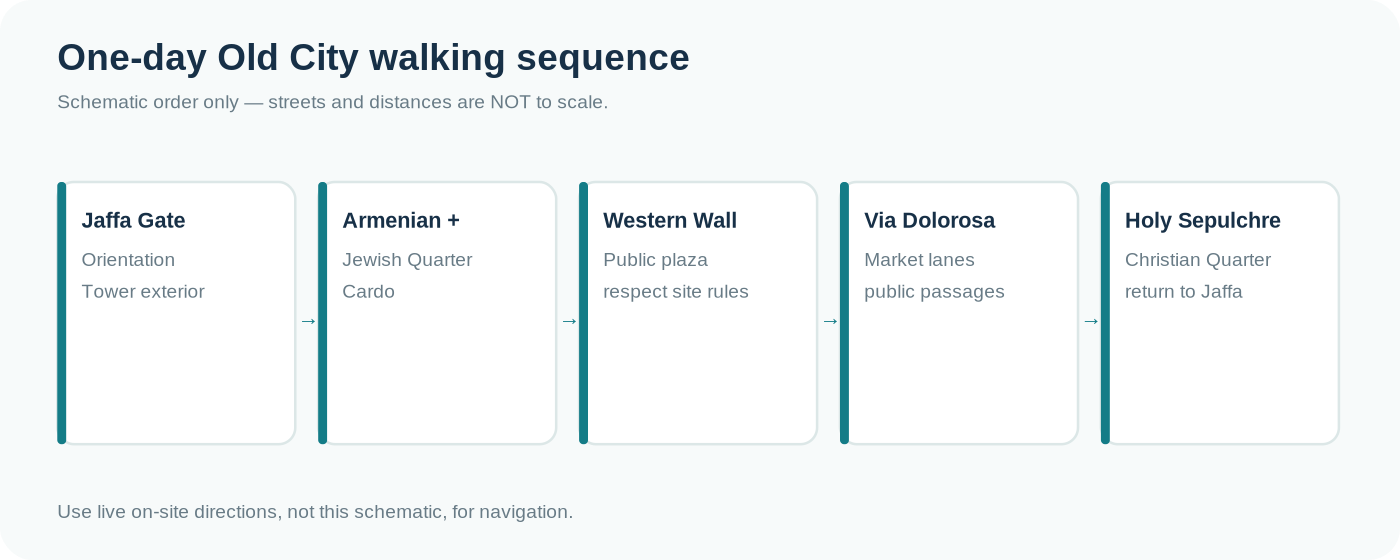
Before you begin: choose the right day and entrance
This route is easiest when you start in daylight and keep your final hour uncommitted. Jaffa Gate is an intuitive entrance from the west side of Jerusalem; it connects well with the Mamilla area and the historic streets just inside the wall. The city tourism guide distinguishes Jaffa Gate from Zion Gate, New Gate and Damascus Gate. They are not interchangeable starting points for the sequence below.
Wear shoes with grip. Polished stone gets slick in rain, and some lanes have stairs or uneven paving. Take water, sun protection, a modest layer for religious sites and a phone with an offline map. Avoid assuming that every narrow alley is public or that every courtyard allows photography.
Saturday, Friday and religious holidays may change business openings, worship access and transit. For the Western Wall, the Heritage Foundation’s visitor guidance notes special expectations on Shabbat and holidays: avoid photography, writing and use of electronic devices at the prayer plaza then. At Christian sites, worship takes priority over sightseeing. A flexible route is more respectful and more practical than a minute-by-minute sprint.
09:00 — Start at Jaffa Gate
Stand just outside Jaffa Gate long enough to orient yourself. The surrounding walls show how the Old City sits above the newer streets to the west. Inside the gate, you are close to the Tower of David complex. This itinerary treats the exterior as an orientation stop, not a mandatory museum visit. Entering the museum may involve a separate ticket and would take a substantial part of your day.
Pick a simple rule for the morning: do not follow every souvenir-stall turn. You are heading broadly toward the Armenian and Jewish Quarters before the Western Wall. If you want a museum morning instead, replace two subsequent stops rather than trying to add everything. The value of a one-day route lies in a manageable sequence.


09:30 — Walk through the Armenian Quarter
From Jaffa Gate, take the streets toward the Armenian Quarter rather than rushing straight downhill. This area has its own long community history and a noticeably different rhythm from the central shopping streets. Many buildings are active residential or religious spaces. A quiet walk here is about noticing stonework, doorways and the structure of a lived-in neighbourhood, not entering private precincts.
If a courtyard, church or religious compound is closed, do not wait at its gates or seek an unmarked entrance. Continue toward the Jewish Quarter on public lanes. Zion Gate can be a short exterior detour for people interested in the city walls, but it adds walking and is not necessary for the main route. If time is tight, skip it and proceed directly.
Optional: Zion Gate without turning the route into a loop
A photo pause near Zion Gate can help you understand how the southern Old City connects with Mount Zion. Return toward the Jewish Quarter rather than heading outside the walls for additional attractions. Sites on Mount Zion are best treated as a separate outing if you have only one day.
10:00 — Jewish Quarter and the Cardo
The Jewish Quarter introduces a different layer of Jerusalem. The Cardo, a reconstructed and excavated section associated with the Roman and Byzantine street pattern, makes it easier to imagine the city as a sequence of changing periods. Some areas are public passages; exhibitions or paid interiors may have separate conditions. Take the time to read interpretive signs where available.
Nearby lanes and small squares can be lively, but they are not a reason to block doorways or photograph people at prayer. The quarter’s narrow gradients mean the remaining walk is not simply flat. Leave yourself a little more time than a digital map’s ideal walking estimate suggests.
This is a good place for a water break before descending toward the Western Wall. The descent is part of the route’s geography; your return toward the Christian Quarter will involve another set of lanes and gradual climbs. Do not treat the Cardo as a shortcut to the Wall without checking signs.
11:00 — Visit the Western Wall Plaza
The Western Wall is a sacred site and functioning prayer space, not just a viewpoint. The Western Wall Heritage Foundation provides rules on clothing, behaviour and items that may not be brought into the plaza. Be prepared for security checks, and follow guidance about prayer areas, photography and Shabbat observance.
The Foundation’s directions page describes the prayer plaza as accessible 24 hours a day, but that does not mean all approaches, nearby attractions or guided tunnels are open at every hour. In this itinerary, the stop is the public plaza only. The Western Wall Tunnels are a separate ticketed experience and should not be casually added to a busy one-day route.
Use 30–45 minutes as a flexible allowance. You may need less if you simply want to observe respectfully, or longer during busy religious periods. Keep bags close and ask staff if you are unsure about photography or which area is appropriate to enter.


12:00 — Take a proper lunch break
Around midday, leave space for a sit-down meal or a simple takeaway lunch in the market streets that connect the quarters. The aim is to rest, not complete a city-wide food tour. Many establishments have short opening windows around religious dates, and some accept only certain payment methods. Check a current menu before ordering if price matters.
Carry your rubbish until you find an appropriate bin. In busy commercial lanes, keep a clear path for residents and deliveries. If you prefer a quieter break, choose an open seating area rather than the steps of a prayer space. A one-hour pause makes the later visit to the Holy Sepulchre more meaningful than rushing through lunch to meet an artificial schedule.
13:15 — Follow Old City market lanes toward the Via Dolorosa
After lunch, head into the Muslim Quarter on public market lanes, following current signs toward sections associated with the Via Dolorosa. This famous pilgrimage route is not one broad boulevard. It crosses lived-in streets that host shops, homes, prayer and daily commerce. Different traditions and guidebooks may describe the Stations of the Cross in detail, but this itinerary does not require you to locate every station.
The goal is to experience a few linked streets while moving toward the Christian Quarter, not to reverse direction repeatedly for a full religious procession. If an alley is temporarily closed or crowded, use marked alternatives and ask official visitor staff. Avoid assuming a shortcut through a courtyard or compound is permitted.
Where the walking gets slower
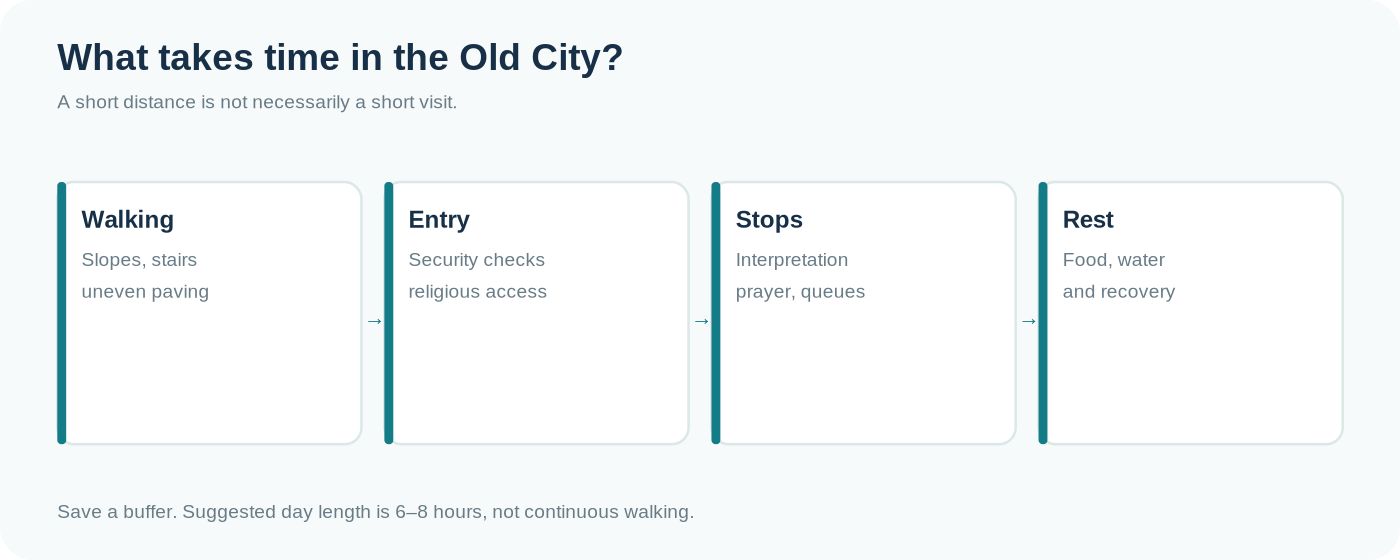
Crowded arches, steps, delivery carts and sudden turns all affect pace. On a map, the Old City is compact. In practice, a short distance can take longer than expected, especially when people are stopping at shrines or markets. Keep conversations and photography considerate around worshippers. If this section becomes too crowded, use your offline map to reach the Church of the Holy Sepulchre by a more direct public route instead.
14:15 — Church of the Holy Sepulchre
The Church of the Holy Sepulchre is one of the most important places of Christian pilgrimage. It contains multiple chapels and traditions within a complex space that is shared by different Christian communities. Whether you are religious or not, enter with the understanding that people may be worshipping, grieving or waiting patiently at a shrine.
Allow at least an hour for an unhurried look, and be ready to shorten or lengthen that time based on services and queues. Do not promise yourself access to every interior chamber. Rules and operating conditions can change with religious calendars, restoration and security measures. Modest clothing and quiet behaviour are appropriate; follow staff instructions on photography.
For visitors interested mainly in the site’s architecture and atmosphere, a thoughtful visit to the principal accessible spaces is more valuable than trying to get a photograph of every object. If there is a long queue for a specific shrine, decide whether waiting fits your remaining day rather than pushing through others.


15:45 — Return through the Christian Quarter to Jaffa Gate
From the church, follow signed public lanes through the Christian Quarter back toward Jaffa Gate. This final stretch is deliberately simple. It allows time to revisit a street, find a coffee or buy a small souvenir without stranding you at an unfamiliar gate just before dusk.
You should be back near Jaffa Gate in the late afternoon on an ordinary day. If worship services or security restrictions slowed the route, return directly instead of adding another museum. The walk works because it has a definite finish.
If you are leaving by taxi or public transport, choose a specific agreed pickup location outside the Old City. Road closures and pedestrian-only lanes can make “pick me up at the market” an unhelpful instruction. Plan onward transport before your phone battery gets low.
How much walking is it? Distance, elevation and accessibility
For a route that stays inside the Old City and returns to Jaffa Gate, budget approximately 3–5 km of walking depending on minor detours, repeated lanes and optional visits. This is an editorial planning range, not a measured GPS track. It is intentionally different from the distance of a straight line between major landmarks. Plan 6–8 hours total because the stops, not the raw kilometres, determine the day.
| Condition | What it means for your day | Better response |
|---|---|---|
| Narrow or sloping stone lanes | The route is more tiring than a flat urban stroll | Wear grippy shoes and take breaks |
| Steps and uneven surfaces | Some passages cannot be treated as wheelchair routes | Ask official accessibility services about viable entrances |
| Religious service or holiday | Interior visiting may be restricted | Continue the route and return only if access permits |
| Busy plaza or security check | Timed stops may slip | Preserve the route order, shorten optional browsing |
| Rain | Polished paving can become slippery | Reduce detours and avoid rushing downhill |
| Unexpected area closure | A shortcut may be unavailable | Use signed public lanes; never cross barriers |
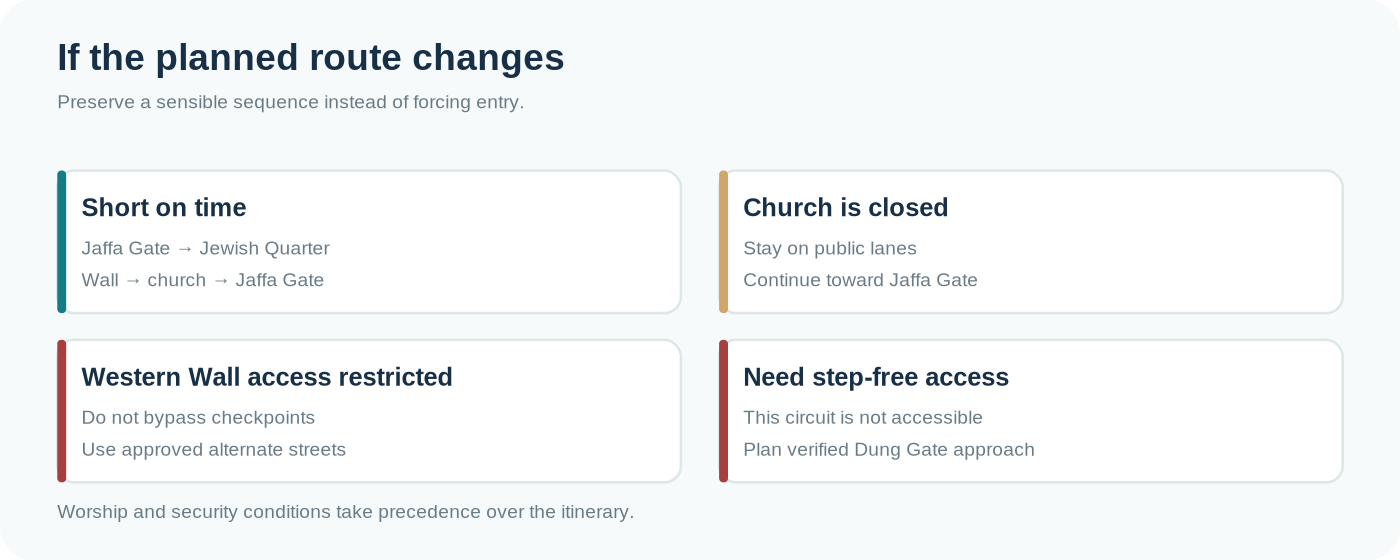
The Western Wall Heritage Foundation notes that wheelchair access to the plaza is via Dung Gate. This entire Jaffa Gate circuit is not marketed as an accessible route. Anyone needing a step-free itinerary should plan a different route with verified current pathways and transport support.
Two useful variations
Shorter route: about half a day
If you only have 3–4 hours, start at Jaffa Gate, walk toward the Jewish Quarter, visit the Western Wall Plaza, then head directly to the Church of the Holy Sepulchre before returning to Jaffa Gate. Skip the Armenian Quarter detour, prolonged market browsing and detailed Via Dolorosa exploration. This is a shorter sequence, not a guarantee of a particular walking distance or queue time.
If a religious site is not accessible
If entrance to the Church of the Holy Sepulchre is delayed, visit its surrounding public lanes and continue to Jaffa Gate. If the Western Wall approach is restricted, do not try to bypass a checkpoint; use an approved alternative street and keep the rest of the route. No visitor should feel obliged to cross a barrier to “complete” a published itinerary.
The Temple Mount / Haram al-Sharif is not included as a routine stop. Access policies and religious practices are sensitive and can change, and non-Muslim entry is subject to restrictions. Treat any visit as a separate matter that requires current official confirmation rather than a casual addition to an already full day.
Safety and respectful travel in Jerusalem
Jerusalem is a living city with different faiths and communities sharing a small area. Dress thoughtfully, observe photo restrictions, avoid demonstrations, and follow instructions from security personnel and site staff. Do not approach restricted entrances because an old map marks them as public. Check your own government’s travel guidance and the latest local alerts before walking.
The U.S. State Department’s Israel advisory, updated 23 October 2026, remains at Level 3: Reconsider travel because of terrorism and unrest. Advisories are not predictions about an individual street or date, but they are important planning information. Have an onward transport plan and know where to obtain official help if conditions change.
For ideas outside this day route, read our Things to Do in Jerusalem hub. For a completely different kind of outing, the Outdoor Activities in Jerusalem guide covers parks and nature. If you prefer organised walking with a local guide, compare current tour inclusions and meeting points rather than assuming every tour follows this exact sequence.
Frequently asked questions
Can you walk around Jerusalem’s Old City in one day?
Yes, for a carefully chosen sequence of stops. Allow approximately 6–8 hours with breaks. You cannot comfortably visit every attraction in that time.
Where should I start a self-guided Jerusalem walking tour?
Jaffa Gate is a practical start for the route in this article, especially when approaching from the west side of the city. Other gates suit other itineraries; choose the correct one before setting out.
How far is this Jerusalem one-day walk?
Budget roughly 3–5 km, depending on detours and chosen passages. This is a planning estimate, not a surveyed GPX distance. Stairs and pauses often matter more than total kilometres.
Do I need tickets for this itinerary?
The public walking route and Western Wall plaza are not presented as ticketed attractions. Optional museums, exhibitions and specialist tours may charge; check their official sites before adding them.
Can I do the walk on Shabbat or a religious holiday?
Walking may still be possible, but transport, businesses and places of worship can operate differently. At the Western Wall Plaza, follow the site’s specific Shabbat restrictions on photography and devices.
Is the route wheelchair-accessible?
Not as written. The Old City has stairs and uneven lanes. The Western Wall’s official guidance identifies Dung Gate as the wheelchair-accessible approach to the plaza; plan a separately verified accessible route.