
Jerusalem is better known for its stone streets than for its open spaces, but you don’t have to leave the city to find a good walk. Urban parks, a former railway corridor, wildlife habitat and green valleys offer different kinds of time outdoors. Beyond the city, the Jerusalem Hills and the Judean Desert are more demanding choices that require proper transport and current access checks.
Where to start: For an easy outing, choose Gazelle Valley or Sacher Park. For an urban bike ride, look at Train Track Park. If you want a genuine hike, research an open, marked Jerusalem Hills route. Save desert adventure for a date when official trail notices, weather and security guidance support it.
Which outdoor activity in Jerusalem fits you?
| Activity | Typical effort | Best conditions | Transport need | Main planning issue |
|---|---|---|---|---|
| Sacher Park walk or picnic | Easy | Comfortable daytime weather | Central-city access | Sun exposure; events may affect use |
| Gazelle Valley nature visit | Easy | Daylight, moderate temperature | City bus or taxi may help | Seasonal closing time, wildlife rules |
| Train Track Park walking or cycling | Easy to moderate depending on distance | Dry weather and good visibility | Reach one of its city access points | Shared paths, cyclists and pedestrians |
| Jerusalem Park green-space outing | Easy to moderate | Cooler hours; check trail surfaces | Depends on section | Length, elevation and access |
| Jerusalem Hills marked hike | Moderate to strenuous | Cooler dry days, confirmed open trails | Often requires a car or arranged transport | Closures, navigation and return pickup |
| Guided Judean Desert excursion | Varies widely | Only with safe weather and official access | Prearranged guide and transport | Flash floods, heat and regional restrictions |
These are general activity categories, not certified difficulty ratings or route permissions. Conditions and physical demands vary within each category.
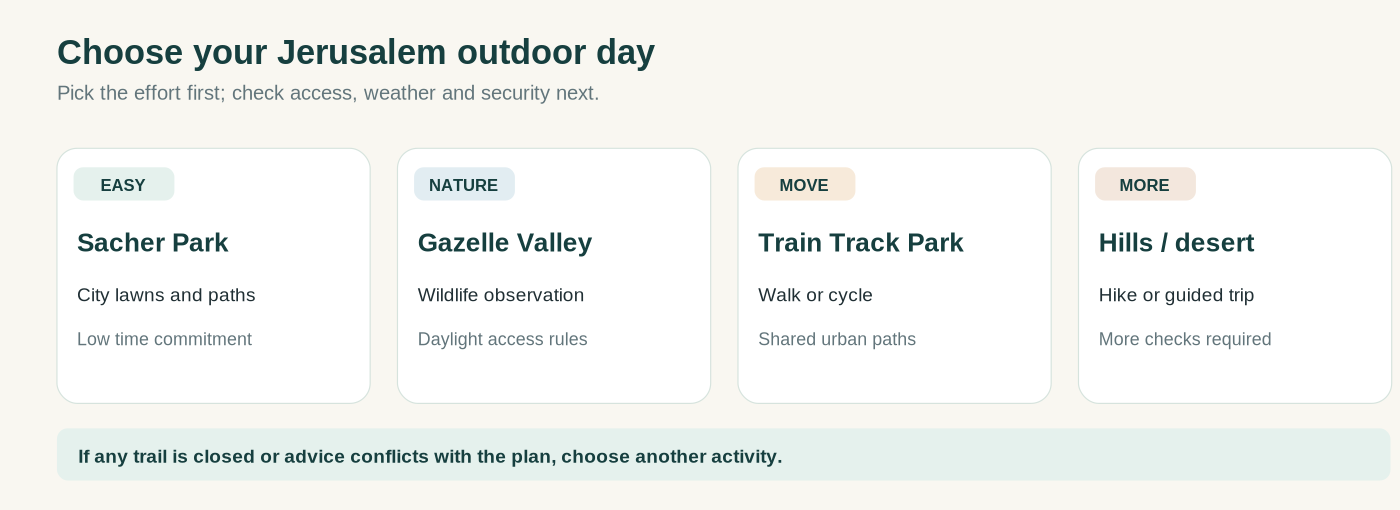
1. Walk or picnic in Sacher Park
Sacher Park is an uncomplicated choice for anyone who wants to be outdoors without committing to a hike. Its open lawns and paths offer space to sit, stretch your legs or spend an hour with a book. It is particularly useful between two busy museum or Old City days because you can adapt the visit to your energy level.
A park is not a substitute for weather planning. Bring drinking water and consider shade in warmer months. In winter, exposed grass can be wet and uncomfortable after rain. Large public gatherings or special events may change access to parts of the park; do not assume every patch of lawn is usable at all times.
There is no need to hire a guide for an ordinary city park visit. If you are looking for several no-fee options in the same trip, see our free things to do in Jerusalem guide.
2. Watch wildlife in Gazelle Valley
Gazelle Valley is a protected urban nature park with walking paths, ponds, birds and a free-roaming gazelle population. Its value is not the chance to get close to an animal, but the ability to observe wildlife from a respectful distance. This makes it a good choice for people who want natural scenery without a challenging trail.
The park’s official visitor page says that admission is free, it operates during daylight hours and dogs are not allowed. Feeding or touching gazelles is prohibited, and visiting hours change through the year. There is also a last-entry cutoff before the gates close, so don’t arrive near dusk relying on a fixed clock time quoted elsewhere.
Walk slowly, keep your voice down near observation areas, and bring binoculars if birdwatching matters to you. Some paths are accessible for wheelchairs and strollers, although conditions should be checked with the park for individual needs.


3. Try Jerusalem’s Train Track Park on foot or by bike
Train Track Park, also called Park HaMesila or Railway Park, follows a former railway corridor through several Jerusalem neighborhoods. The Jerusalem Development Authority describes a linear green space of about seven kilometers with paths for both cycling and walking, places to sit and links to other urban open spaces.
It is a more predictable introduction to city cycling than trying to navigate busy roads without local experience. But it is still shared public space: slow down around pedestrians, watch for crossings and make sure your bike and route are suitable. A cycle route does not mean uninterrupted right of way. Rentals, opening hours and any specific access restrictions should be checked separately.
You do not have to cover the full corridor. A short section on foot lets you see how a former transport route has become part of neighborhood life. For people who want dedicated cycling information rather than a broad overview, use our planned Jerusalem cycling guide after its URL is confirmed and the page is published.
4. Explore the green spaces around Jerusalem Park
The larger Jerusalem Park system connects valleys and green areas around the city’s outskirts. According to the Jerusalem Development Authority, it includes places such as Emek Refaim, Emek Motza, Emek Arazim and Nahal Tzofim, with walking and cycling opportunities. These are different landscapes, not one continuous flat city promenade.
Choose a section based on the route’s current condition, how you intend to arrive and whether you can get back without relying on an infrequent bus. A green line on a map does not show elevation, surface quality or temporary closures. If you are not used to hills, start with a smaller area rather than planning to complete a full loop.
Urban nature areas can be particularly pleasant in spring, when vegetation is greener. After rainfall, however, mud and runoff can change conditions. Summer heat may make an exposed valley much harder than it looks in a photograph.


5. Move into the Jerusalem Hills for a proper hike
The Jerusalem Hills offer forested slopes, valleys and more substantial walking than the city parks. They also involve a different standard of preparation. A hillside trail may have loose stones, uneven steps, seasonal vegetation and stretches without convenient public transport.
Start by checking a trail with an authoritative local land manager. KKL-JNF’s Jerusalem Hills guidance describes woodland trails and advises visitors to contact its forest hotline for closures or extreme-weather updates. That is the right level of diligence for a day hike: confirm the route, access points, weather, permitted areas and return transport before leaving.
A detailed route deserves its own guide, with verified map data and local safety notices. This overview intentionally does not provide turns or GPS instructions. If you need those, use our dedicated Jerusalem hiking guide once available, alongside up-to-date official maps.
What changes when a walk becomes a hike?
- Footwear: city shoes may be fine on a promenade; a rocky path needs better grip.
- Water: refill points that exist in city parks may be absent in the hills.
- Navigation: offline maps help, but trail markings and official notices take precedence.
- Return plan: an out-and-back route and a one-way route have different transport demands.
- Daylight: start only if you can finish comfortably before dark.


6. Consider a guided desert adventure, with extra caution
The Judean Desert is sometimes marketed as an easy excursion from Jerusalem. It can be beautiful, but the environment is not forgiving of casual planning. Dry riverbeds can flood after rain elsewhere in the drainage basin, even when the sky above you is clear. Summer heat, steep terrain, access controls and regional security concerns matter as much as the advertised activity.
Check Israel Nature and Parks Authority alerts and the details of the reserve you intend to visit. As of early November 2026, the authority reported closures affecting some trails after flooding, and its En Gedi information described restricted access and advance registration requirements. Never take an old itinerary as proof that a wadi, pool or scenic road is open today.
If you book a guide, ask where the activity takes place, whether the route is currently permitted, what the physical demands are, how weather cancellations work and what safety equipment and transport are included. Do not enter closed trails or restricted border-adjacent areas, regardless of what an old tour listing says. For a commercial experience, check the guided desert tours overview once the dedicated guide is published; this article does not rank operators.
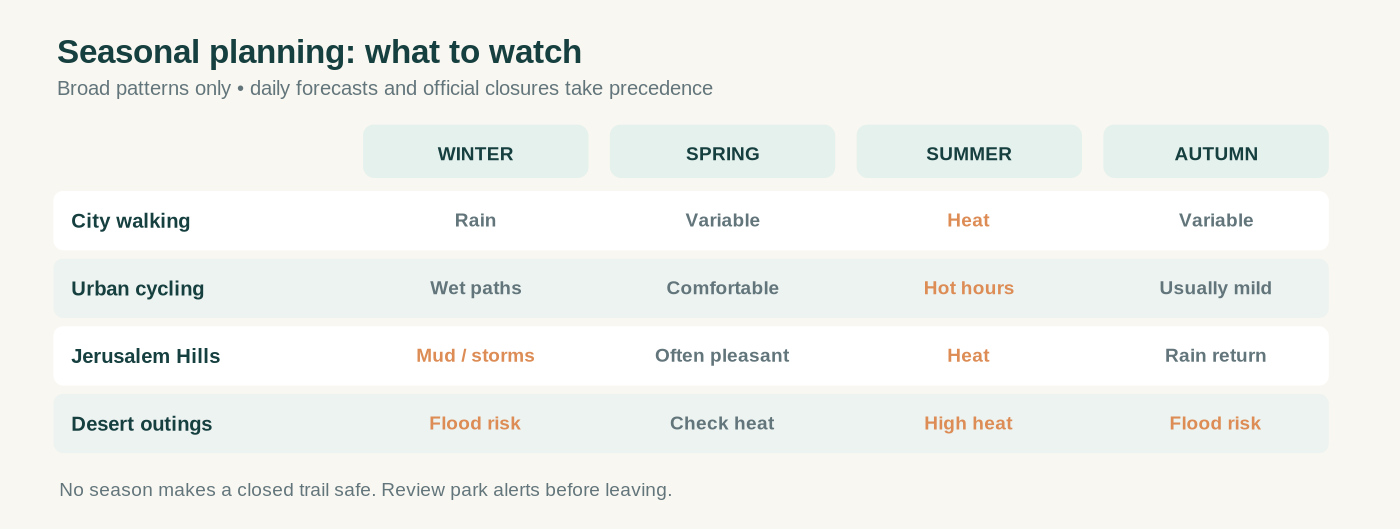
How the seasons change your plans
| Period | Usually more comfortable options | What to monitor |
|---|---|---|
| Winter | Short city walks between showers; green parks on dry days | Rain, wind, slippery surfaces and flash-flood forecasts |
| Spring | Park walks, urban cycling, hills on confirmed trails | Variable temperatures, holiday crowds and trail conditions |
| Summer | Early or late urban walks with shade and water | Heat stress, exposed roads and high temperatures |
| Autumn | City parks and outdoor culture as temperatures ease | First heavy rains, sudden flood risk and daylight changes |
These are broad seasonal tendencies rather than guarantees. For outdoor plans, the local forecast for the specific day is more useful than the season label.
Getting to outdoor sites without a car
For city parks, local buses, light rail and taxis can be useful, depending on the location. The Train Track Park has several urban access points. Gazelle Valley’s website lists public transport connections, but you should check live schedules and accessibility information before leaving.
For forest routes and desert outings, the question is not just how to reach the start. It’s also how to get back at a sensible hour. Check whether a walk ends in a different place, whether your phone will have coverage and whether the return service runs on the day you travel. Shabbat and holidays affect many conventional public transport services. Read our Israel transport guide for broader planning.
Safety checks that matter more than the weather app icon
- Confirm official access. The parks authority’s notices describe trail closures and flood restrictions that a general map may not display.
- Check the security situation. The U.S. State Department’s 23 October 2026 Israel advisory is Level 3, with Level 4 restrictions for certain areas. Follow the relevant advice for your nationality and current local instructions.
- Allow for heat, cold and water needs. An urban walk and a desert hike require very different amounts of preparation.
- Don’t improvise into a reserve. Use only permitted trails, obey signs and ranger instructions, and turn back if the plan no longer fits the conditions.
Frequently asked questions
Can you hike near Jerusalem without a car?
Some urban trails and parks are reached by public transport. Many Jerusalem Hills trailheads are harder to access and require careful return planning. Check the specific route rather than assuming all walks have convenient buses.
Where can beginners enjoy nature in Jerusalem?
Gazelle Valley and Sacher Park are manageable starting points for easy outdoor time. They are not interchangeable: Gazelle Valley is a protected wildlife site with daylight access and stricter visitor rules.
Is Jerusalem good for cycling?
There are city cycle paths, including Train Track Park, as well as more demanding routes around the metropolitan park system. Check trail surfaces, shared-path rules, current closures and your skill level.
Can I visit the Judean Desert from Jerusalem?
Possibly, depending on your route, weather, official access and security guidance. Desert trips should not be treated as automatic add-ons; check current restrictions and use an appropriately qualified operator when needed.
Sources and verification
- Jerusalem Development Authority — Train Track Park
- Jerusalem Development Authority — Jerusalem Park system
- Gazelle Valley Park — official visitor information
- KKL-JNF — Jerusalem Hills trail guidance
- Israel Nature and Parks Authority — closure and flood notices
- Israel Nature and Parks Authority — En Gedi visitor restrictions
- U.S. State Department — Israel advisory
Editorial note: the proposed links to dedicated hiking, cycling and desert guides are not necessarily live. Check CMS, current route access, reserve rules and sources immediately before publication.