
Seven days in Israel is enough to experience more than one kind of place—but not enough to see everything. This itinerary moves from the Mediterranean coast to Jerusalem and then south to Eilat. It works best for independent travelers who can arrive early, leave late, travel light and confirm that each journey is appropriate under current security guidance.
Important before booking: As of 3 November 2026, the U.S. State Department’s Israel advisory remains at Level 3, “Reconsider Travel,” with specific areas at Level 4. Your own government’s advice may differ. This route is a planning template, not a statement that travel is safe on any particular date. If the advice or your circumstances make travel unsuitable, postpone the itinerary.
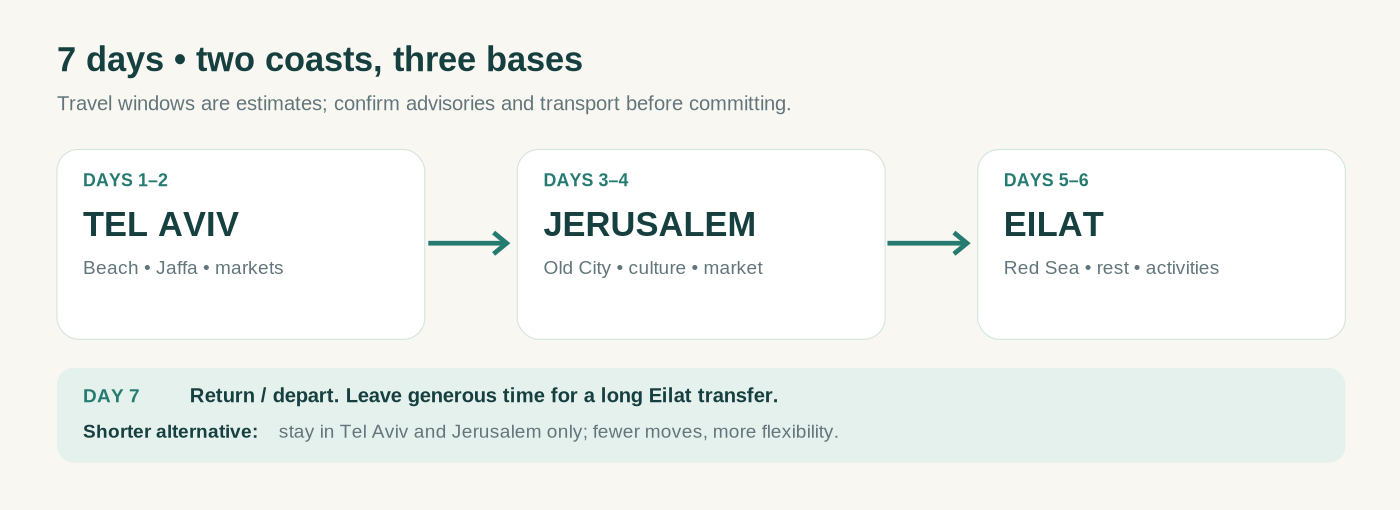
Your one-week route at a glance
| Day | Overnight base | Main plan | Travel allowance |
|---|---|---|---|
| 1 | Tel Aviv | Arrive, settle in, beach promenade and a neighborhood dinner | Airport-to-city journey varies |
| 2 | Tel Aviv | Jaffa, markets and time by the Mediterranean | Local transit or walking |
| 3 | Jerusalem | Travel by rail; start with the Old City | About 40–50 min on the train from central Tel Aviv stations, plus station access |
| 4 | Jerusalem | Museum or market, then a slower city afternoon | Local journeys only |
| 5 | Eilat | Reserve most of the morning for the southbound bus | Allow roughly 4–6 hours door to door or more |
| 6 | Eilat | Red Sea and a flexible sea-or-desert day | Depends on chosen activity |
| 7 | Departure / Tel Aviv | Return north or depart through an appropriate airport | Long transfer; avoid tight flight connections |
These are approximate planning windows, not guaranteed service times. Exact travel durations, fares, departures and route conditions must be checked with operators for your dates. The Eilat leg is optional; see the alternative below.
Day 1: Arrive in Tel Aviv and keep the first day simple
Use your arrival day for one neighborhood, not five landmarks. After the airport transfer, leave your luggage, pick up a local SIM or check roaming, and walk toward the beachfront if time and conditions allow. The promenade is a straightforward introduction to the city, with sea views, cafés and people out for an evening walk.
Choose accommodation with a clear route from the airport and a cancellation policy you understand. Abraham Tel Aviv is one option to check, but confirm live availability and prices before making plans. If your flight lands late, skip the beach and eat near your accommodation instead.
Practical choice: Arriving on a Friday or during a holiday can change the transfer completely. Don’t assume that a weekday train or bus timetable applies. Airport taxi prices are not interchangeable with public transport fares.
Day 2: Discover Jaffa and the Mediterranean coast
Spend the morning in Jaffa, where streets, historic architecture, food businesses and the old port create a different rhythm from central Tel Aviv. Walk at your own pace and give yourself time to return along the coast. This is a good day to keep spending flexible: buy food when you are hungry rather than planning an expensive attraction for every hour.
If you want a second activity, choose one: a museum, a market, a short guided walk or an evening event with verified operating details. Tel Aviv’s nightlife is spread across several neighborhoods, so don’t automatically assume you can walk home from every venue.


Day 3: Train to Jerusalem, then explore the Old City
Travel to Jerusalem in the morning, ideally without carrying much luggage. Direct trains commonly connect Tel Aviv stations with Jerusalem–Yitzhak Navon; current published journey times are around 40–50 minutes from central stations. The full door-to-door journey is longer because the railway station, accommodation and Old City are not in one place. Check Israel Railways before selecting a departure.
Once settled, spend the afternoon exploring the Old City at a respectful pace. The Western Wall and the Church of the Holy Sepulchre are significant active religious sites; entry conditions can change. Do not make access to sensitive places the only purpose of the day. You can still understand a great deal by walking public streets and visiting an open museum.
Save the evening for a simple meal around the city center. If you’d prefer an admission-free afternoon, use our free things to do in Jerusalem guide.
Day 4: Choose the Jerusalem experience that suits you
A full second day means you can choose depth over distance. History-focused travelers may prefer the Israel Museum or the Tower of David Jerusalem Museum, subject to tickets and opening hours. For local food and everyday life, spend time around Mahane Yehuda Market and nearby streets. If you need open air, consider a city park during daylight rather than adding a rushed cross-country trip.
The Temple Mount/Haram al-Sharif has particular religious sensitivities and varying access rules. Check authoritative guidance and local security instructions rather than treating it as a guaranteed stop. Friday, Saturday and religious holidays can affect markets, museum hours and transport in different ways.


Day 5: Travel south to Eilat without overplanning the afternoon
Eilat is the biggest logistical commitment in this route. Egged lists Jerusalem–Eilat bus services, including lines 444 and 445. The precise journey and route depend on the service. Reserve a large transfer window of roughly half a day and check the bus operator’s current timetable, reservations and service notices.
After checking in, keep the rest of the day light. Walk by the waterfront, find dinner and prepare for the next day. Don’t stack a timed desert excursion onto an arrival day that already involves a long journey.
Eilat is not a reason to ignore regional warnings: some southern and border-adjacent areas may be restricted under official advice, even when a city itself is not named in the same way. Do not improvise detours toward border zones. Choose only legal, currently operating connections and activities consistent with official restrictions.
Day 6: Red Sea or desert, not both at full speed
For a relaxed day, stay near Eilat and plan time around the coast, swimming or an organized marine activity. Check official beach notices, water conditions, protected-area rules and any activity operator’s safety information. A snorkel rental, boat trip or marine attraction may carry an additional fee. Never assume a particular beach has lifeguards or that conditions are suitable for swimming.
An alternative is a guided desert activity with a licensed operator, only when the selected area is currently open and appropriate. Heat, sudden flooding in dry channels and route closures are real considerations. The Israel Nature and Parks Authority published trail-closure and flood notices in early November 2026; check those notices before choosing any desert route.
You can review live accommodation details on Abraham Eilat’s official page. Tour and hostel services should be confirmed for your travel dates, not inferred from older reviews.


Day 7: Return north—or depart without a risky connection
If your international flight departs from Ben Gurion Airport, the journey back from Eilat can take much of the day. Check the operator’s route, traffic, possible disruptions and the airline’s check-in requirement. Do not book a tight same-day international connection based solely on the bus’s advertised journey time. An extra night near the departure airport may be more sensible.
If departure arrangements do not support this long final transfer, remove Eilat from the plan before booking. The shorter version below is often easier to manage than spending your final holiday hours on a bus.
A lower-transfer seven-day alternative
Not everyone wants three cities in one week. For a trip with fewer moving parts, use four nights in Tel Aviv and two in Jerusalem, or reverse those bases depending on your flight and interests. You can keep the remaining day free for a second museum, a coastline day or a local guided activity that is confirmed to be operating. This version makes it easier to avoid expensive last-minute transfers and gives more flexibility if schedules change.
| If you care most about… | Choose |
|---|---|
| Sea and a relaxed social base | More time in Tel Aviv |
| History, faith and museums | More time in Jerusalem |
| The Red Sea | Keep Eilat only if travel time and conditions genuinely work |
| Fewer check-ins, less spending | Two bases rather than three |
Public transport, Shabbat and entry planning
- Rail: Use Israel Railways for live routes and service alerts. Changes to some lines were announced on 2 November 2026 for implementation from 14 November 2026; avoid treating a saved screenshot as a future timetable.
- Long-distance buses: Egged provides information on Eilat routes and services that require reservations.
- Shabbat: Many public train and bus services stop or reduce service from Friday afternoon into Saturday evening. Tel Aviv runs a separate free weekend transport network, but it does not replace intercity travel everywhere.
- Entry documents: Travelers from visa-exempt countries may need an approved ETA-IL before boarding. Check passport, nationality and visa rules on the official government site.
- Costs: Budget beyond the base room rate for local transit, intercity journeys, meals, admission fees and a schedule-change buffer. See the Israel travel budget guide.
Frequently asked questions
Is seven days enough for Israel?
Yes for a focused two-city trip, or a faster three-stop journey if transport conditions allow. Seven days is not enough to visit every region meaningfully.
Can I do this Israel itinerary without a car?
The main city-to-city legs have train or bus options, but schedules, reservations and weekend gaps need careful checking. Not every natural attraction can be reached conveniently by public transport.
Should I include Eilat in a one-week Israel trip?
Only if the Red Sea is a major priority and the transfer fits your arrival, departure and security requirements. Otherwise, stay longer in Tel Aviv and Jerusalem.
Is it sensible to travel between Jerusalem and Eilat on Shabbat?
Don’t assume a particular bus will run. Confirm your exact date directly with the operator; holiday patterns may differ from an ordinary weekend.
Sources and verification
- U.S. State Department — Israel advisory, issued 23 October 2026
- Israel Railways — official train schedules and alerts
- Egged — reserved services and Eilat routes
- Tel Aviv–Yafo Municipality — weekend transport
- Israel Population and Immigration Authority — ETA-IL
- Israel Nature and Parks Authority — closure notices
Editorial note: travel windows are broad planning allowances. Reconfirm current travel advisories, entry requirements, timetable changes, transport operator reservations, accommodation and attraction access before publishing or booking.